Показаны сообщения с ярлыком Ted-Ed. Показать все сообщения

четверг, 24 октября 2019 г.

TED-Ed: Blood


Click the link below and see Diana's lesson about our blood.
Blood

To know more about blood follow the link How artificial blood works!
Follow the link and test your knowledge about blood Blood quiz.
Good luck!

Comment do you like this lesson?

пятница, 17 февраля 2017 г.

Disease


For several centuries, people though diseases were caused by wandering clouds of poisonous vapor. We now know that this theory is pretty ridiculous, and that diseases are caused by specific bacteria. But how did we get to this new idea of germ theory? Tien Nguyen describes the work of several scientists who discredited a widely accepted theory in a way that was beneficial to human health.
Watch the video How a few scientists transformed the way we think about disease by Tien Nguyen, that was created with support from the U.S. Office of Research Integrity: http://ori.hhs.gov.


вторник, 31 января 2017 г.

What happens when your DNA is damaged?

The DNA in just one of your cells gets damaged tens of thousands of times per day. Because DNA provides the blueprint for the proteins your cells need to function, this damage can cause serious issues—including cancer. Fortunately, your cells have ways of fixing most of these problems, most of the time. Monica Menesini details the processes of DNA damage and repair.

пятница, 20 января 2017 г.

History through the eyes of the potato

Baked or fried, boiled or roasted, as chips or fries; at some point in your life you’ve probably eaten a potato. But potatoes have played a much more significant role in our history than just that of the dietary staple we have come to know and love today. Leo Bear-McGuinness shares how without the potato, our modern civilization might not exist at all.

пятница, 13 января 2017 г.

Antibiotic resistance

Right now, you are inhabited by trillions of microorganisms. Many of these bacteria are harmless (or even helpful!), but there are a few strains of ‘super bacteria’ that are pretty nasty -- and they’re growing resistant to our antibiotics. Why is this happening? Kevin Wu details the evolution of this problem that presents a big challenge for the future of medicine.
Watch the video

What causes antibiotic resistance?


пятница, 28 октября 2016 г.

How Mendel's pea plants helped us understand genetics

 Each father and mother pass down traits to their children, who inherit combinations of their dominant or recessive alleles. But how do we know so much about genetics today? Hortensia Jiménez Díaz explains how studying pea plants revealed why you may have blue eyes. 

среда, 21 сентября 2016 г.

The wacky history of cell theory

Scientific discovery isn't as simple as one good experiment. The weird and wonderful history of cell theory illuminates the twists and turns that came together to build the foundations of biology.
Here ther is a story by Lauren Royal-Woods.

View full lesson: http://ed.ted.com/lessons/the-wacky-h...

четверг, 10 марта 2016 г.

MATHS AND NATURE


"The laws of nature are but the mathematical thoughts of God"
                                                                                      - Euclid

Mathematics is everywhere in this universe. We seldom note it. We enjoy nature and are not interested in going deep about what mathematical idea is in it. Here are a very few properties of mathematics that are depicted  in nature.

SYMMETRY

Symmetry is everywhere you look in nature.
Symmetry is when a figure has two sides that are mirror images of one another. It would then be possible to draw a line through a picture of the object and along either side the image would look exactly the same. This line would be called a line of symmetry. 
There are two kinds of symmetry.
One is bilateral symmetry in which an object has two sides that are mirror images of each other. 
The human body would be an excellent example of a living being that has bilateral symmetry.
The other kind of symmetry is radial symmetry. This is where there is a center point and numerous lines of symmetry could be drawn. 
The most obvious geometric example would be a circle.
Not all objects have symmetry; if an object is not symmetrical, it is called asymmetric.

Symmetry in mathematics

Symmetry occurs in many areas of mathematics. Symmetry comes from a Greek word meaning 'to measure together' and is widely used in the study of geometry. Mathematically, symmetry means that one shape becomes exactly like another when you move it in some way: turn, flip or slide. For two objects to be symmetrical, they must be the same size and shape, with one object having a different orientation from the first. 
The mathematical study of symmetry is systematized and formalized in the extremely powerful and beautiful area of mathematics called group theory.
Symmetry can be present in the form of coefficients of equations as well as in the physical arrangement of objects. By classifying the symmetry of polynomial equations using the machinery of group theory, for example, it is possible to prove the unsolvability of the general quintic equation.

You can see a video lesson about symmetry on ed.ted.com/lessons


четверг, 3 марта 2016 г.

ARCHIMEDES. FATHER OF MATHEMATICS


CONTRIBUTIONS TO MATHEMATICS
Archimedes, a Greek mathematician is considered one of the three great mathematicians along with Isaac Newton and Carl Fredrick Gauss. . His greatest contributions to mathematics were in the area of Geometry. Archimedes was also an accomplished engineer and an inventor. He discovered the method to determine the area and volumes of circles, spheres and cones. Archimedes invented the water screw, a machine for raising water to bring it to fields. His crane was reportedly used in warfare during the Roman siege of his home, Syracuse. Another invention was a miniature planetarium, a sphere whose motion imitated that of the earth, sun, moon, and the five planets that were then known to exist.
A FAMOUS STORY 
There are many stories about how Archimedes made his discoveries. A famous one tells how he uncovered an attempt to cheat King Hieron. 
The king ordered a golden crown and gave the crown's maker the exact amount of gold needed. The maker delivered a crown of the required weight, but Hieron suspected that some silver had been used instead of gold. He asked Archimedes to think about the matter. One day Archimedes was considering it while he was getting into a bathtub. He noticed that the amount of water overflowing the tub was proportional (related consistently) to the amount of his body that was being immersed (covered by water). This gave him an idea for solving the problem of the crown. He was so thrilled that he ran naked through the streets shouting, "Eureka!" (Greek for "I have discovered it!"). 
There are several ways Archimedes may have determined the amount of silver in the crown. One likely method relies on an idea that is now called Archimedes's principle. It states that a body immersed in a fluid is buoyed up (pushed up) by a force that is equal to the weight of fluid that is displaced (pushed out of place) by the body. Using this method, he would have first taken two equal weights of gold and silver and compared their weights when immersed in water. Next he would have compared the weight of the crown and an equal weight of pure silver in water in the same way. The difference between these two comparisons would indicate that the crown was not pure gold.

 You can see his story on ed.ted.com/lessons

To see another story go ed.ted.com/lessons


вторник, 1 марта 2016 г.

Euclid. What's the point of Geometry?

Euclid (Greek Eukleides) was the most prominent mathematician of Greco-Roman antiquity. He was born c. 300 BCE in Alexandria, Egypt). Euclid best known for his treatise on geometry, his work 'the Elements'. Today we are going to know what some geometrical terms are ...


EUCLID’S FAMOUS QUOTES:
“The laws of nature are but the mathematical thoughts of God”


“ There is no other Royal path which leads to geometry”.
THE ELEMENTS:

The Elements is divided into 13 books.
  • The first books deals with plane geometry.
  • Books  7to 9 deals with number theory.
  • Book 10 deals with the theory of irrational numbers .
  • Books 11 to 13 deals with three-dimensional geometry .

Euclid's Elements is remarkable for the clarity with which the theorems are stated and proved.


Study ed.ted.com/lessons to know How to prove a mathematical theory

EUCLID'S OTHER WORKS :       
  • ON DIVISION deals with plane geometry.
  • The book DATA discusses plane geometry and contains propositions.
  • PHAENOMENA is a work by what we call today as applied mathematics, concerning the  geometry of spheres for use in astronomy. 
  • THE OPTICS, corrects the belief held at the time that the sun and other heavenly bodies are actually the size they appear to be to the eye.
  • CONICS was a work on conic sections.

среда, 8 апреля 2015 г.

Should we eat bugs?


Do you know what Entomophagyis?
Entomophagy is the practice of eating insects - including arachnids (tarantulas) and myriapods (centipedes).


The word “entomophagy” derives from the Greek term éntomos, or éntomon, meaning, “insect(ed),” literally meaning “cut in two,” referring to an insect’s segmented body, and phăgein, “to eat.” Combined, the two terms mean, “insect eating.”
As a point of information the word itself is a rather new term. There’s no record of its coinage in the Oxford English Dictionary and its first usage to denote a human behavior may well be as recent as the 1950s.
There are no words equivalent to ‘entomophagy’ in the languages of the many ethnic groups that practice insect consumption, simply because these peoples never distinguished between insects and other varieties of food.

Why eat bugs?


Insects have served as a nutritional, tasty and safe food source for people for tens of thousands of years, all over the planet. Today insect eating is rare in the developed world, but eating insects is a common practice in over 13 countries. Insects remain a popular food in many developing regions of Central and South America, Africa, Australia and Asia. It’s only a matter of time till Eurocentric based cultures, like the United States, Canada and Europe catch on. Read more here.


Emma Bryce, one of Ted-Ed member created an interesting video lesson about the topic, click to watch: ed.ted.com


четверг, 13 ноября 2014 г.

Ted-Ed: Diagnosing a zombie

Hallo!

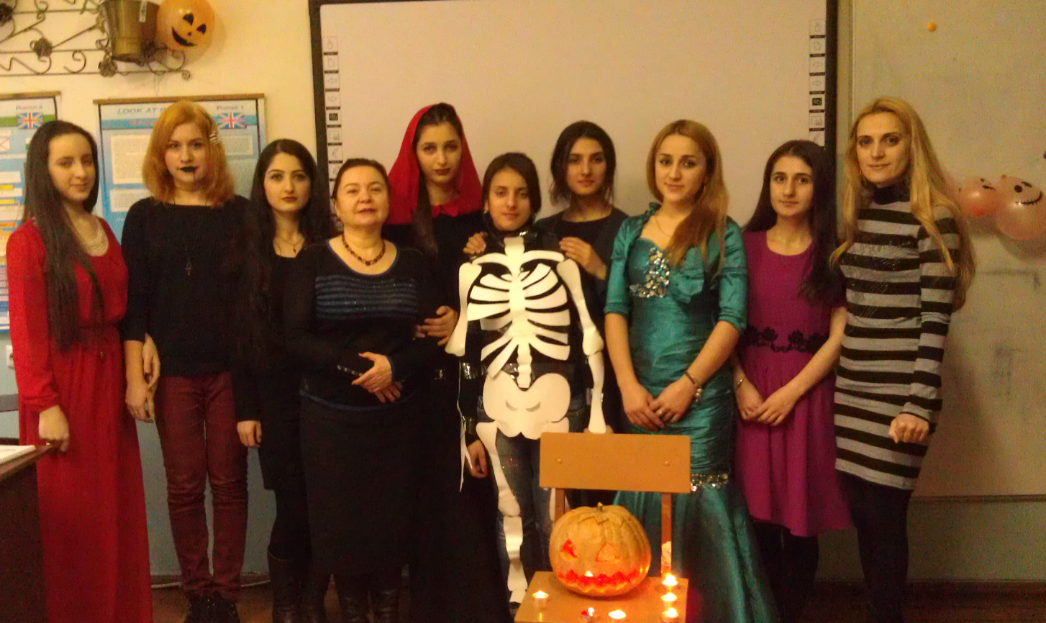
Язык невозможно изучать в отрыве от традиций и культуры его носителей. Поэтому обойти стороной такой колоритный праздник как Халловин было бы просто грубейшей оплошностью. Члены кружка английского языка биологического факультета “What, where and when” подготовили красочное выступление. 
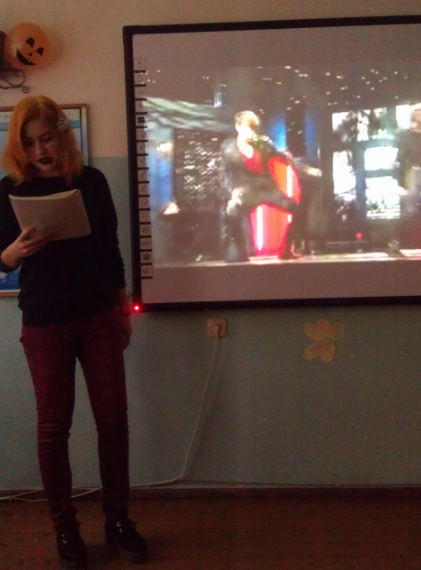
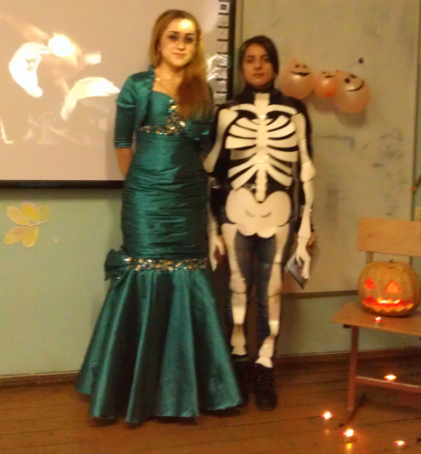
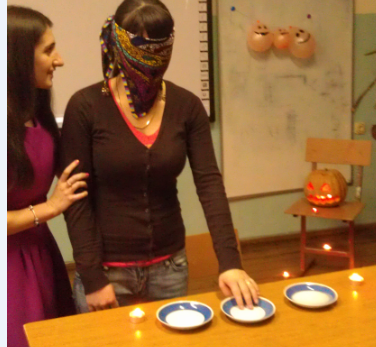
Студенты воплотились в образы ярких представителей англоязычной “нечистой силы”: в вампиров, русалок, ходячих скелетов. Не остались забытыми и мифологические персонажи славян: Кощей Бессмертный, кикимора, оборотни и прочие. Выступления сопровождались яркими презентациями и видеороликами. Зрители участвовали в традиционном английском гадании “Три блюдечка”.
 
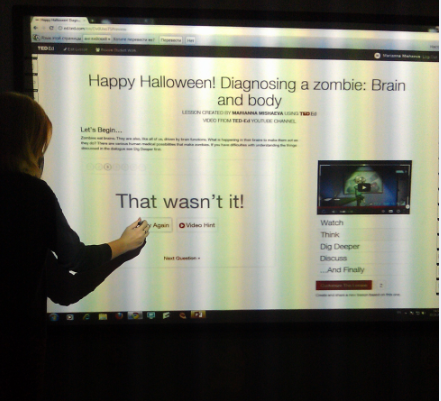
Вторая часть мероприятия была посвящена сложностям диагностирования зомби. Участники и зрители просмотрели видеоурок Happy Halloween: Diagnosing a zombie. Урок был разработан на платформе TED-ED, одном из инструментов Web 2.0. На интерактивной доске студенты выбирали  ответы и проверяли их правильность.
 
Праздник удался. Зрители и участники были довольны. Руководитель кружка Рабаданова Саният Меджидовна в заключительном слове отметила, что такого рода мероприятия призваны расширить кругозор и мотивируют изучение языка.
 

Today  I want to share a video lesson Diagnosing a zombie that is used in our Halloween party. See Dig Deeper before answering the questions.

The Father of Microbiology

  1. Do you know who invented the first compound microscope?  2. Can you say who discovered bacteria, free-living and parasitic microscopic ...